XMS Airdrop Details: Mars Ecosystem Token Distribution, Current Price, and How It Works
 Dec, 26 2025
Back in 2024, the XMS airdrop grabbed attention from crypto users looking for free tokens. But if you’re checking this in December 2025, you need to know one thing upfront: the main XMS airdrops are over. No new free distributions are happening. If you missed them, you can’t get XMS for free anymore - at least not through official channels.
What Is XMS and Why Did People Care?
XMS is the governance token for Mars Ecosystem, a DeFi project trying to build what they call "the central bank and reserve currency for DeFi." Their goal was simple: fix the broken parts of existing stablecoin systems. Most stablecoins like USDT or USDC rely on centralized reserves. Mars Ecosystem wanted to create a fully decentralized alternative with its own stablecoin, USDM, backed by a mix of crypto assets and governed by token holders. The ecosystem had three main parts:- USDM - the stablecoin pegged to the U.S. dollar
- MarsSwap - a decentralized exchange for trading USDM and other tokens
- XMS - the token that lets you vote on protocol changes and earn rewards
The Two Big XMS Airdrops - What Happened?
There were two major ways to get XMS tokens for free. Both are now closed.1. Mars Ecosystem’s Original Airdrop
Early in the project’s life, Mars Ecosystem ran a small airdrop: 50 XMS tokens each to 1,000 people. That’s 50,000 XMS total. It was a way to seed early users and build a core community. You had to sign up on their website, connect a wallet, and sometimes complete simple tasks like joining their Telegram group. Tokens were sent to BEP-20 wallets within three days after the event ended. That campaign closed in early 2024.2. CoinMarketCap Learn & Earn Airdrop (The Big One)
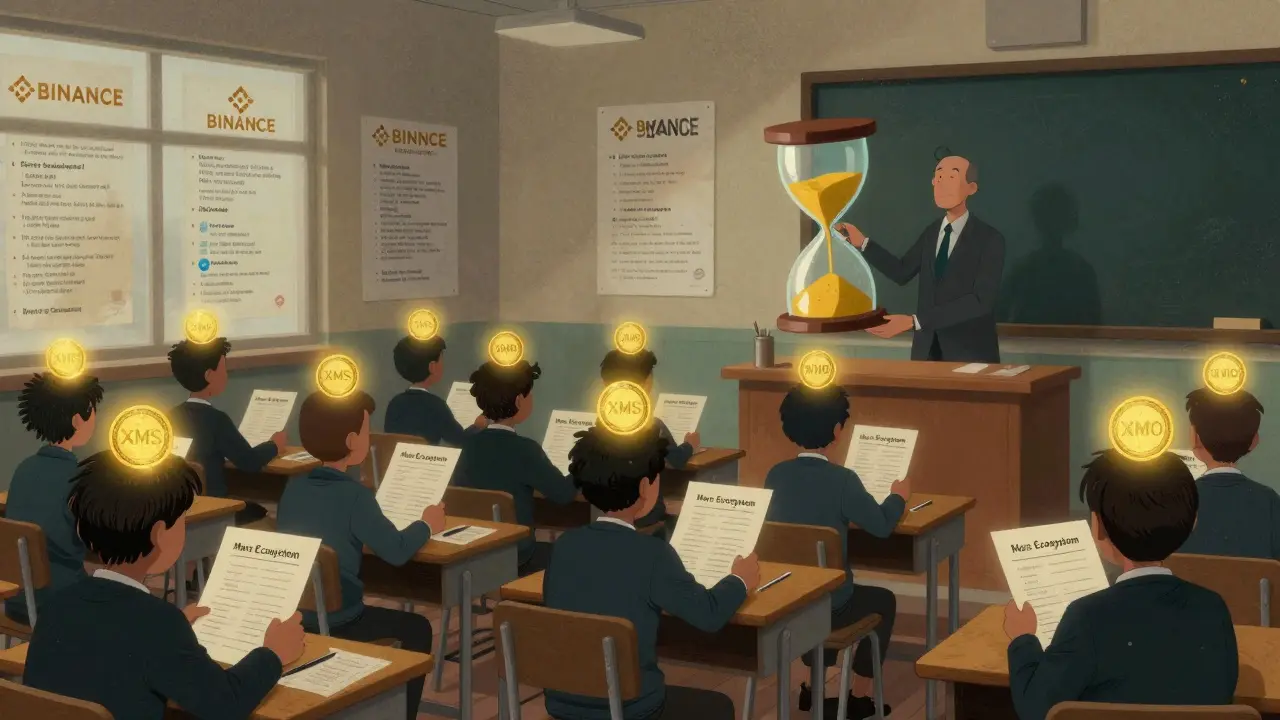
This was the real deal. In mid-2024, CoinMarketCap teamed up with Mars Ecosystem to give away $200,000 in XMS tokens. That’s 40,000 winners - each got $5 worth of XMS. Here’s what you had to do:- Have an active CoinMarketCap account
- Have a Binance account (and a verified one at that)
- Watch two short educational videos about Mars Ecosystem
- Pass a 5-question quiz with 100% accuracy
- Submit your BEP-20 wallet address (like MetaMask or Trust Wallet)
Where Is XMS Trading Today?
As of December 2025, XMS is still listed on exchanges, but it’s not moving much. Liquidity is thin. Trading volume hovers around $2,300 per day - that’s barely enough to fill a single large order on bigger platforms. Here’s the price mess:- Binance: $0.000297
- CoinMarketCap: $0.0004989
- CoinGecko: $0.000312 (estimated)
Why Did XMS Struggle to Grow?
Mars Ecosystem had a good idea. But ideas don’t win in crypto - execution does. Here’s what went wrong:- No real adoption: USDM never took off. Merchants didn’t start accepting it. No big DeFi protocol integrated it.
- Too reliant on Binance: Requiring a Binance account for the biggest airdrop scared off decentralized purists. It felt centralized.
- Weak community: No active Reddit, no big Twitter following, few Discord discussions. People lost interest fast.
- Competition: MakerDAO, Curve, and Frax already owned the stablecoin space. Mars Ecosystem didn’t offer anything new enough to switch.
Is XMS Still Active?
Yes - but barely. The official website is still up. The bug bounty program on Immunefi is active, offering up to $10,000 for security flaws. That’s a good sign. Someone’s still maintaining the code. But there’s no roadmap update. No new team announcements. No token unlock schedule. No new partnerships. The last major update was in Q1 2024. If you’re holding XMS, you’re holding a speculative asset with no clear path to value. It’s not a utility token anymore. It’s not a governance token with power. It’s just a token on a chain, with no one using it.
Can You Still Get XMS Today?
Only by buying it. You can trade XMS on:- Binance (main listing)
- Bitrue
- Some smaller DEXs on Binance Smart Chain
What Should You Do Now?
If you missed the airdrop:- Don’t chase it. Don’t buy XMS hoping for a rebound. The odds are stacked against it.
- Look for new projects. There are dozens of new DeFi protocols launching airdrops right now. Focus on ones with real traction, active teams, and clear utility.
- Learn from this. The best airdrops come from projects with real users, not just marketing.
- Hold only if you’re okay losing it all. Treat it like a lottery ticket.
- Don’t stake it. There’s no yield program anymore.
- Check your wallet. Make sure you’re not holding it on an exchange. Move it to your own BEP-20 wallet if you haven’t already.
Final Thoughts
The XMS airdrop was a classic crypto story: big promise, weak follow-through. It started with energy, attracted thousands, and then faded quietly. The project didn’t fail because of bad tech. It failed because no one cared enough to use it. Crypto moves fast. Projects rise and fall in months. Mars Ecosystem was one of many that tried to build the next big thing - and didn’t make it. If you want to find the next XMS, don’t look for free tokens. Look for teams that ship products, not press releases. Look for communities that talk about usage, not price charts. The airdrop is over. The lesson? Always ask: "Who’s actually using this?" If the answer is "no one," walk away.Was the XMS airdrop real?
Yes, the XMS airdrops were real. Mars Ecosystem ran two official campaigns: a small one with 50 XMS per winner, and a larger one with CoinMarketCap that gave $5 in XMS to 40,000 people. Both required completing educational tasks and submitting a BEP-20 wallet. Tokens were distributed as promised.
Can I still get free XMS tokens?
No. Both major airdrop campaigns ended in 2024. There are no active free distribution programs as of December 2025. Any website claiming to offer free XMS now is likely a scam.
Why is XMS price different on Binance and CoinMarketCap?
The price difference comes from low liquidity. XMS trades in very small volumes - under $2,500 per day. That means even small buy or sell orders can swing the price. Binance and CoinMarketCap pull data from different exchanges, and with so little trading, the numbers don’t match. This is normal for low-cap tokens, but it’s a red flag for reliability.
Is XMS built on Ethereum?
No. XMS runs on the Binance Smart Chain (BSC), which uses BEP-20 tokens. That’s why airdrop participants had to submit a BEP-20 wallet address. It’s not on Ethereum or Solana.
What happened to the Mars Stablecoin (USDM)?
USDM never gained real adoption. While it was technically functional, no major DeFi protocol integrated it, and no merchants started accepting it. The partnership with MugglePay was announced but never followed up with public usage data. As of 2025, USDM is essentially inactive.
Should I invest in XMS now?
No, not unless you’re okay losing your money. XMS has no active development, no community growth, and no clear use case. Its market cap is under $400,000, and trading volume is negligible. It’s a speculative asset with zero fundamentals. Better to wait for projects with real traction.