Security Risks in Cross-Chain Transfers: How to Protect Your Crypto
 Jun, 21 2026
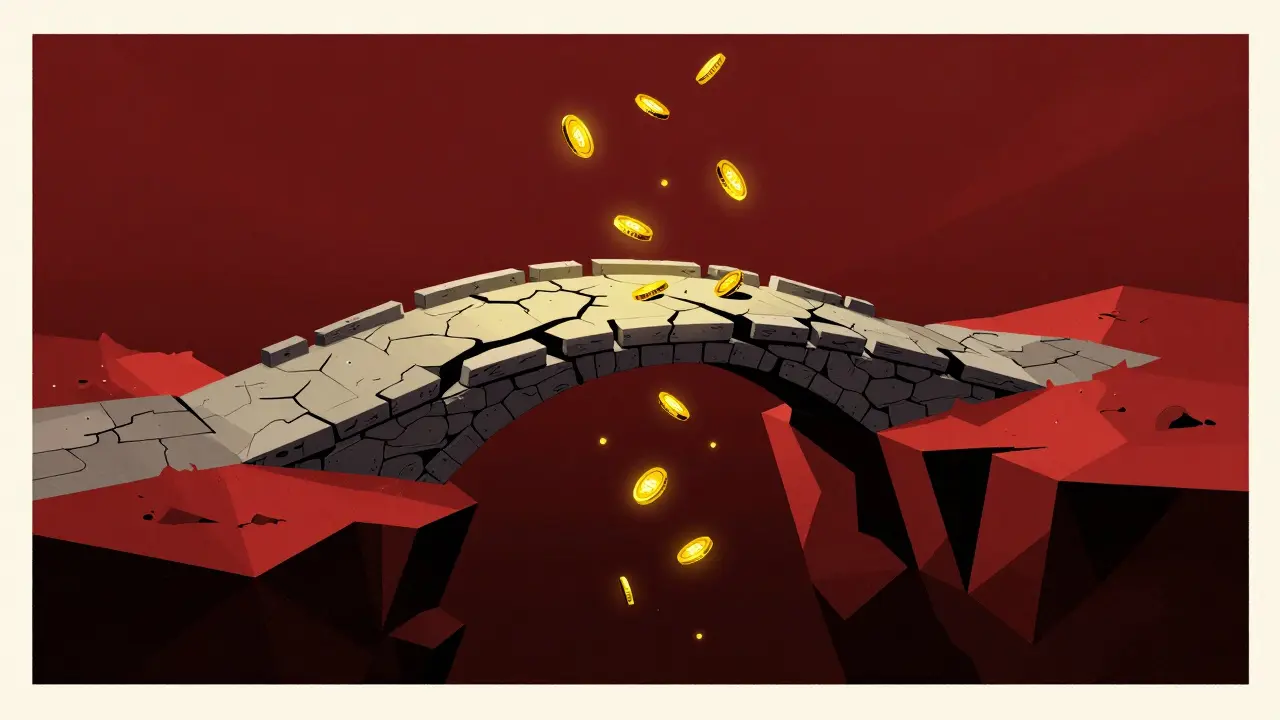
Imagine moving $10,000 from your bank account to another bank. You trust the system because it’s regulated, insured, and has existed for decades. Now imagine doing that same transfer between two completely different digital ledgers-say, Ethereum and Solana-where no single entity is responsible if things go wrong. That is cross-chain transfers, a technology that allows assets to move between independent blockchain networks. It sounds convenient, but right now, it is one of the most dangerous places to keep your cryptocurrency.
In 2022 alone, hackers stole over $2.35 billion from cross-chain bridges, accounting for 64% of all stolen crypto value that year. As of mid-2024, cumulative losses have surpassed $2.5 billion. If you are using decentralized finance (DeFi) or holding assets on multiple chains, understanding these risks isn’t just technical trivia-it’s essential for keeping your money safe. This guide breaks down exactly where the vulnerabilities lie, which bridges are safer, and how you can protect yourself from becoming the next statistic.
The Hidden Architecture of Bridge Hacks
To understand why cross-chain transfers are risky, you first need to understand how they work. Blockchains like Bitcoin, Ethereum, and Polygon do not talk to each other natively. They are isolated islands. To move assets between them, we use "bridges." These bridges act as translators and messengers, locking your asset on Chain A and minting a representative token on Chain B.
This process creates several critical points of failure. The fundamental problem is verification: how does Chain B know for sure that a transaction actually happened on Chain A? Most bridges solve this by relying on a group of validators or a centralized custodian. According to BuiltIn’s analysis in July 2023, 73% of bridges rely on some form of centralized entity or a limited validator set. This contradicts the core promise of blockchain decentralization. If those validators collude, get hacked, or lose their private keys, the entire bridge fails.
Consider the Multichain hack in July 2023. Attackers didn’t break complex cryptography; they simply compromised the private keys controlled by the protocol’s CEO. Because those keys held absolute authority, attackers drained $125 million. This highlights a recurring theme: many bridges look decentralized on the surface but operate with central points of control that are easy targets.
Common Technical Vulnerabilities You Should Know
Beyond simple key theft, there are sophisticated technical flaws that exploit the differences between blockchain architectures. Here are the most common ones:
- Oracle Manipulation: Bridges often rely on oracles (data feeds) to confirm transactions. In January 2024, the Orbit Chain hack occurred when attackers compromised seven of ten multisig private keys and fed false data to the bridge, tricking it into releasing $15 million without corresponding inputs. Chainlink’s March 2024 report noted that oracle manipulation affected 41% of vulnerable bridges.
- State Verification Failures: Some bridges skip rigorous checks like Merkle proofs to save time or gas fees. Instead, they accept simplified state roots. Webisoft’s data shows that state verification failures accounted for 28% of bridge exploits. Essentially, the bridge believes an event happened when it never did.
- Replay Attacks: When a blockchain undergoes a hard fork, old credentials can sometimes be reused on the new chain. Between 2021 and 2024, there were 12 major replay attack incidents causing $87 million in losses. If a bridge doesn’t implement proper nonce systems (unique message identifiers), attackers can replicate fraudulent transactions across chains.
- Signature Scheme Inconsistencies: Different blockchains use different cryptographic standards. Ethereum uses EIP-712, while Solana uses ed25519. Turnkey’s February 2024 analysis found that these inconsistencies increase human error likelihood by 37%. Developers often make mistakes when translating signatures between these incompatible systems.

Trusted vs. Trustless: Which Is Safer?
Not all bridges are built the same. Understanding the architectural difference helps you assess risk before sending funds.
| Bridge Type | How It Works | Security Profile | Speed/Cost |
|---|---|---|---|
| Trusted (Custodial) | Relies on a central entity or small group to lock/mint assets (e.g., Wrapped Bitcoin). | High centralization risk. Single point of failure. However, established players have strong insurance/reputation incentives. | Fastest and cheapest. |
| Trustless (Light Client) | Uses cryptographic proofs to verify events directly on-chain without intermediaries (e.g., early Wormhole attempts). | Higher theoretical security. No single admin can drain funds. But code bugs can still lead to massive losses (e.g., $325M Wormhole hack). | Slower and more expensive due to high gas costs for verification. |
| Liquidity Pool | Assets aren't locked; they are swapped via pools on each chain (e.g., THORChain). | No smart contract holds user funds directly, reducing hack surface area. However, pool imbalances and oracle issues remain risks. | Moderate speed. Prices fluctuate based on pool depth. |
Data from Dune Analytics (April 2024) shows that trusted bridges process about $4.2 billion monthly with relatively few exploits compared to their volume, largely because institutions prefer known entities. However, when they fail, the impact is catastrophic. Trustless bridges offer better decentralization but suffered high-profile failures like the Wormhole hack in February 2022, where a signature validation flaw allowed attackers to steal $325 million.
Red Flags: How to Spot a Risky Bridge
You don’t need to be a cryptographer to spot danger signs. Before using any cross-chain service, check for these red flags:
- Small Validator Sets: Halborn’s 2024 security benchmarking study found that bridges with fewer than 10 validators suffer significantly more successful exploits. Look for protocols with 50+ decentralized nodes. While these may take longer (average 127 seconds vs. 34 seconds for centralized ones), they are far harder to compromise.
- Lack of Audits: Comprehensive security audits cost between $50,000 and $250,000. If a bridge hasn’t been audited by reputable firms like OpenZeppelin, Trail of Bits, or CertiK, avoid it. Check if the audit reports are public and recent.
- Opaque Governance: Who controls the bridge? If the answer is "the founder" or "a private company," you are taking on significant counterparty risk. Decentralized governance models distribute this risk.
- Poor Documentation: Chainlink’s CCIP documentation scores 4.7/5 on developer satisfaction, while lesser-known bridges score around 2.3/5. Good documentation indicates a mature team that cares about transparency and ease of integration.
- No Insurance or Backstop: Does the protocol have a reserve fund or insurance partner? Chainlink’s CCIP launched with $750 million insured by Proof of Reserve. While insurance doesn’t prevent hacks, it provides a path to recovery.
Best Practices for Protecting Your Assets
Even the best bridges can fail. Your personal habits matter just as much as the technology you choose. Here is how to minimize your exposure:
Use Established Protocols Only. Stick to bridges with a long track record and high volume. Wormhole, despite its past hack, has implemented significant upgrades and maintains 24/7 support with 180+ moderators. Chainlink’s CCIP has processed $1.7 billion with zero successful exploits since its September 2023 launch. Avoid new, unknown bridges promising "instant" transfers with "zero fees." Those promises usually hide hidden risks.
Limit Transfer Sizes. Never move your entire portfolio at once. Use per-wallet rate limits if available. Turnkey recommends capping transfers at equivalent of 5 ETH per hour. This ensures that if a hack occurs, your loss is contained rather than total.
Verify Transaction Status Independently. Don’t just trust the UI. After initiating a transfer, check the transaction hash on both the source and destination block explorers. Ensure the funds are actually locked on Chain A before assuming they will appear on Chain B. User reviews on Trustpilot show that 63% of complaints involve lack of real-time status updates.
Keep Private Keys Secure. Since many hacks involve compromised keys, ensure your own wallet is secure. Use hardware wallets, enable multi-signature requirements for large holdings, and never share seed phrases. Remember, in the Multichain hack, the attacker targeted the CEO’s keys. In smaller cases, users phish themselves out of funds.
Monitor for Anomalies. Set up alerts for unusual activity. If a bridge suddenly pauses withdrawals or changes its fee structure drastically, step back. Investigate community channels like Discord or Reddit before proceeding. During the ALEX bridge exploit in May 2024, users who noticed delays and checked forums avoided losing funds.
The Future of Cross-Chain Security
The industry is learning from its mistakes. Regulatory scrutiny is increasing, with the SEC taking enforcement actions against bridge operators in 2024. Technologically, we are seeing a shift toward shared security models. In these models, multiple chains contribute to validating bridge transactions, reducing reliance on a single entity. Early implementations show 76% fewer exploits than traditional architectures.
Additionally, the IETF released draft standards RFC-BB-2024-01 in March 2024, establishing baseline security requirements for cross-chain communication. While adoption takes time, these standards will force lower-quality bridges to improve or exit the market. Gartner predicts that bridge-related losses will drop from 64% to 28% of total DeFi exploits by 2026 as these practices mature.
Until then, caution is your best defense. Cross-chain transfers are powerful tools for accessing diverse DeFi opportunities, but they require vigilance. By choosing audited, decentralized bridges and practicing strict personal security hygiene, you can navigate this space without becoming a victim.
What is the safest way to do cross-chain transfers?
The safest method is using trustless bridges with large, decentralized validator sets (50+ nodes) and robust audit histories, such as Chainlink CCIP or upgraded versions of Wormhole. Always verify transactions on block explorers and limit transfer sizes to mitigate potential losses.
Why are cross-chain bridges so often hacked?
Bridges are hacked because they must verify events across incompatible systems, creating complex codebases with multiple failure points. Many rely on centralized keys or small validator groups, making them attractive targets. Additionally, differences in cryptographic standards between chains introduce implementation errors.
Can I recover my funds if a bridge gets hacked?
Recovery is difficult and not guaranteed. Some protocols have insurance funds or proof-of-reserve mechanisms that allow partial reimbursement. Others rely on community coordination to trace and freeze funds, as seen in the Orbit Chain case. Always check if a bridge offers insurance before using it.
What is the difference between a trusted and trustless bridge?
A trusted bridge relies on a central party or small group to manage assets, offering speed but higher centralization risk. A trustless bridge uses cryptographic proofs to verify transactions without intermediaries, offering better security but slower speeds and higher costs.
Are cross-chain transfers legal?
Yes, cross-chain transfers are generally legal, but regulatory scrutiny is increasing. The SEC has taken action against bridge operators for unregistered securities sales. Users should stay informed about local regulations regarding DeFi and cross-border asset transfers.