What is Onchain AI (OCAI) crypto coin?
 Feb, 25 2026
The Onchain AI (OCAI) crypto coin isn't just another altcoin. It's a blockchain network built around an AI chatbot that lets anyone create smart contracts without writing a single line of code. If you’ve ever thought blockchain development is too technical, too expensive, or too slow, Onchain AI is trying to change that. Launched in July 2023, it’s still early days for this project, but its core idea is bold: merge artificial intelligence with blockchain tools to let everyday people build Web3 apps just by talking to a bot.
What exactly is Onchain AI?
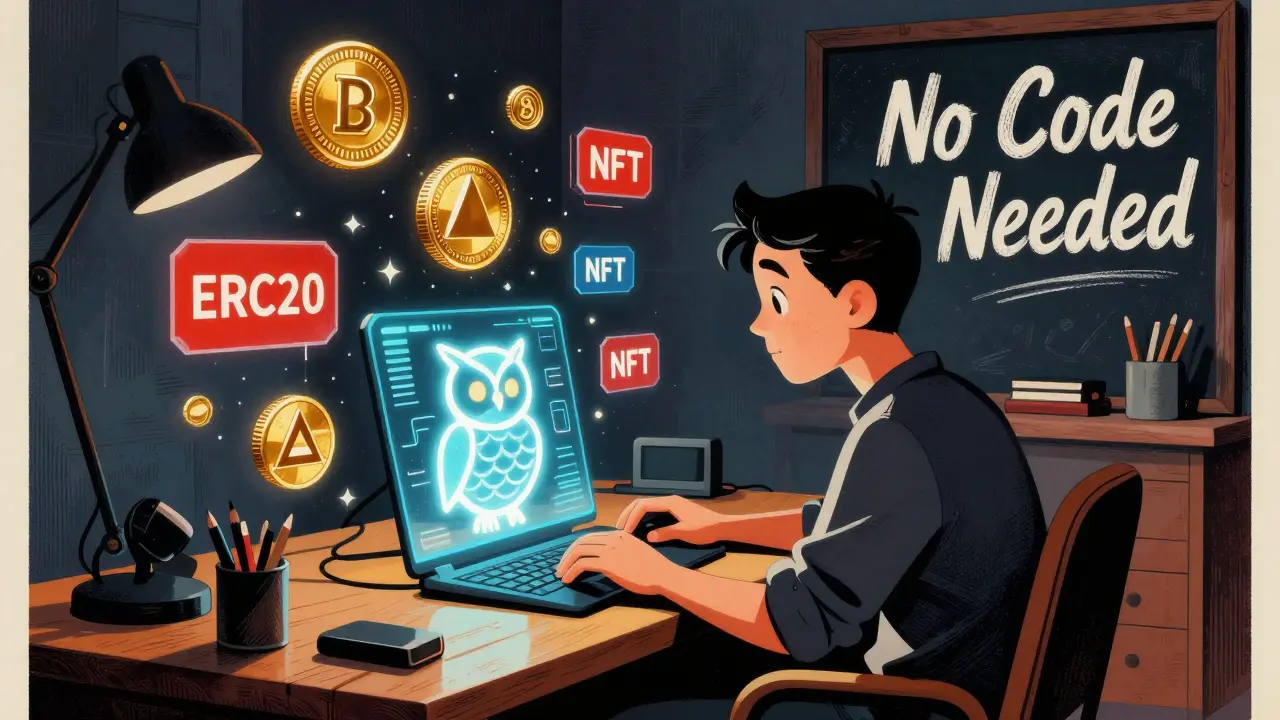
Onchain AI is a Layer-1 blockchain network, meaning it’s its own independent chain-not built on Ethereum or Solana. Its main feature is called WEB3AI a built-in AI chatbot interface that generates and deploys smart contracts based on user instructions. You don’t need to know Solidity, JavaScript, or how to set up a wallet. Just type in plain English-like "Create an ERC20 token called MyCoin with 1 million supply"-and the system handles the rest. It writes the code, tests it, and deploys it to the blockchain automatically.
This isn’t a gimmick. The project claims to have already helped thousands of users create tokens, NFTs, and simple dApps without technical help. For entrepreneurs, hobbyists, or small creators who want to launch their own digital asset but lack coding skills, this is a game-changer.
How does the OCAI token work?
The OCAI token is the lifeblood of the network. It’s not just a speculative asset-it has real utility. Here’s how it’s used:
- Paying for transactions: Every time you deploy a smart contract or store data on the Onchain AI chain, you pay a small fee in OCAI.
- Staking for validation: If you hold OCAI, you can stake it to run a validator node. Validators help secure the network and earn rewards in return.
- Accessing the AI tool: You need OCAI to interact with the WEB3AI chatbot. The more complex your request, the more tokens it costs to process.
The total supply of OCAI is capped at 100 million tokens. As of February 2026, about 90 million are already in circulation. That means the remaining 10 million could be released over time, though the project hasn’t shared a clear emission schedule. This uncertainty makes it hard to predict long-term supply dynamics.
Current price and market performance
As of February 25, 2026, OCAI is trading around $0.00070 to $0.00078, depending on the exchange. That’s a long way from its all-time high of BTC 0.0051894-which translates to roughly $150 per token at today’s Bitcoin price. In fact, OCAI is trading about 98% below its peak.
But it’s not all down. The token bounced back from a low of BTC 0.087451, gaining nearly 200% from its lowest point. That shows some resilience, even if the overall trend is still weak.
Trading volume is extremely low. CoinMarketCap reports $0 in 24-hour volume, while 3Commas and Bilaxy show small amounts-mostly from the OCAI/ETH pair on Bilaxy, which handles about $58,500 in daily trades. That’s not enough to support healthy price discovery. Prices vary wildly across platforms because there’s not enough trading activity to create a stable market.
On CoinGecko, OCAI ranks #6628 by market cap. On CoinMarketCap, it’s #6996. These rankings mean it’s a very small project compared to top coins like Bitcoin or Ethereum. Most of its value comes from speculation, not usage.
Is Onchain AI really using AI?
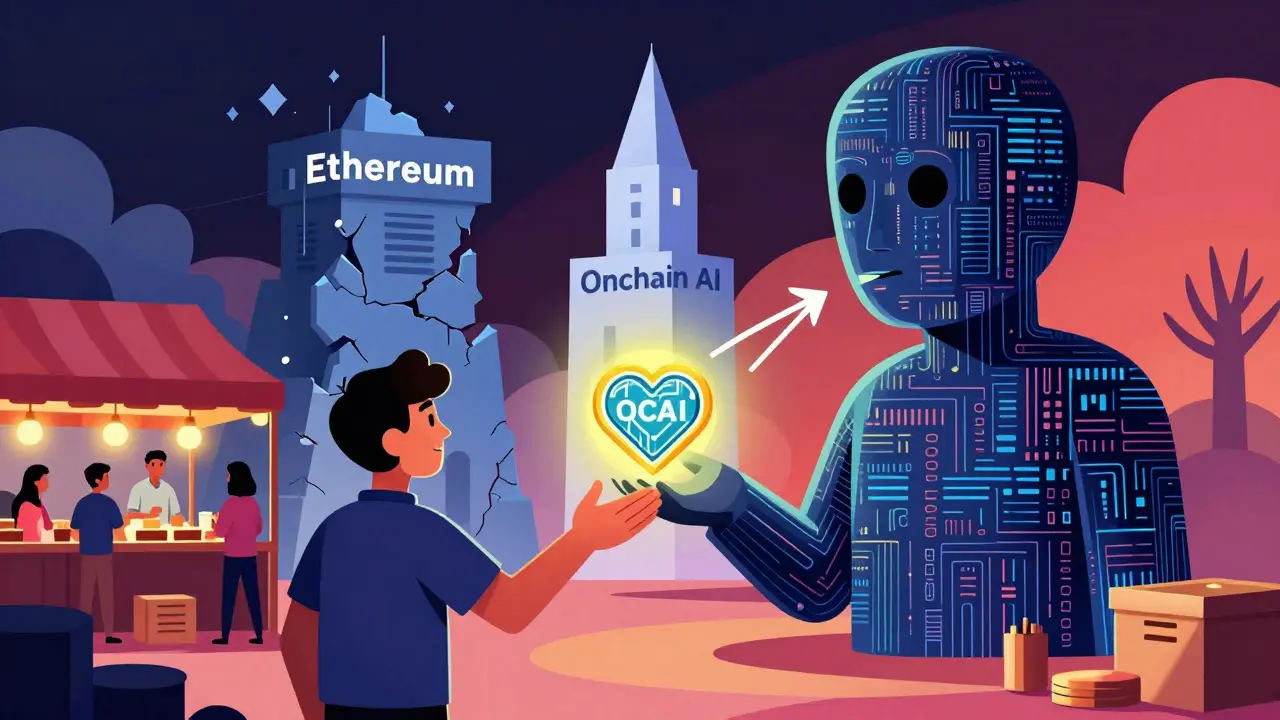
Yes-but not in the way you might think. The AI here isn’t predicting prices or managing wallets. It’s a code generator. Think of it like GitHub Copilot, but for blockchain. You describe what you want, and the AI writes the smart contract. It’s not magic. It’s pattern recognition. The system has been trained on thousands of existing Ethereum-style contracts, so it can replicate structures like ERC20, ERC721, or custom logic based on your input.
There’s no evidence the AI makes decisions on its own, learns from users, or adapts over time. It’s a tool, not a sentient system. But for non-developers, that’s enough. You don’t need to understand how the AI works-just that it works.
Where can you buy and store OCAI?
You can trade OCAI on both decentralized and centralized exchanges. The most active market is on Bilaxy a centralized exchange where the OCAI/ETH trading pair has the highest volume. You can also find it on Uniswap, the decentralized exchange, after it was automatically listed following its presale.
To store OCAI, you need a wallet that supports Ethereum-compatible tokens. The easiest way is through MetaMask a popular browser wallet that supports custom token contracts. Just add the contract address: 0x4309e88d1d511f3764ee0f154cee98d783b61f09. MetaMask lets you add it with a single click via CoinGecko’s integration, so you don’t have to type it manually.
What do price predictions say?
Price forecasts for OCAI are all over the place. LiteFinance predicts it could hit $0.00080 by late 2026. WalletInvestor says it might drop to $0.00070 by 2027, then slowly rise to $0.00093 by 2030. 3Commas sees a range of $0.00079 to $0.00087 in early 2028. Some models even suggest it could reach $0.0011 by 2032-if adoption grows.
But here’s the catch: these predictions are based on tiny sample sizes and low-volume markets. There’s no real data to back them up. Most of these forecasts come from algorithms trained on historical noise, not fundamentals. If you’re thinking of investing, treat these as entertainment-not advice.

Why Onchain AI is risky
There’s no public roadmap. No whitepaper update since launch. No active GitHub repository. No developer community metrics. No clear team behind it. These are red flags for any blockchain project.
Most successful chains-like Solana, Polygon, or Arbitrum-have open-source code, public teams, regular updates, and active forums. Onchain AI has none of that. The website is minimal. Social media accounts are quiet. The project feels like it was launched, listed on Uniswap, and then largely abandoned.
It’s also outperformed by its peers. Over the last week, Ethereum-based tokens rose 12.7% on average. OCAI either dropped 8% or rose 5%, depending on the data source. That inconsistency suggests weak demand and unreliable data.
Low liquidity + no transparency + no community = high risk. You could lose your entire investment. There’s no guarantee the network will keep running. If the team disappears, so does the AI tool-and the whole reason for holding OCAI.
Who is this for?
Onchain AI might be worth a look if:
- You’re a non-technical creator who wants to launch a token or NFT without hiring a developer.
- You’re curious about AI + blockchain experiments and don’t mind high risk.
- You’re holding small amounts of crypto and want to try something different.
But if you’re looking for a long-term investment, a solid team, or a proven track record-walk away. This isn’t Bitcoin. It’s not even Ethereum. It’s an unproven experiment with a cool idea but zero infrastructure.
Is Onchain AI (OCAI) a good investment?
No-not as a serious investment. OCAI has extremely low liquidity, no transparent team, no public roadmap, and minimal community activity. Its price moves wildly between exchanges, and it’s down over 98% from its all-time high. While it’s possible the token could rebound, there’s no evidence the project has the foundation to support long-term growth. Only invest what you’re prepared to lose entirely.
Can I really build a smart contract without coding?
Yes, but with limits. The WEB3AI chatbot lets you generate ERC20 tokens, NFTs, and simple contracts by typing plain English commands. It’s designed for non-developers. However, it can’t handle complex logic like DeFi protocols, multi-signature wallets, or advanced governance systems. It’s useful for basic use cases, not professional development.
Where can I trade OCAI?
The most active trading pair is OCAI/ETH on Bilaxy. You can also trade it on Uniswap. Most other major exchanges don’t list OCAI due to its low volume and lack of regulatory compliance. Always check the contract address (0x4309e88d1d511f3764ee0f154cee98d783b61f09) before trading to avoid scams.
How do I store OCAI safely?
Use MetaMask or another Ethereum-compatible wallet. Add the token manually using the contract address 0x4309e88d1d511f3764ee0f154cee98d783b61f09. Never send OCAI to a wallet that doesn’t support ERC20 tokens. Avoid storing large amounts on exchanges-use a hardware wallet if you plan to hold long-term.
Why is OCAI’s price so inconsistent across platforms?
Because trading volume is extremely low. Most of the activity happens on Bilaxy and Uniswap. Other platforms rely on limited data feeds, which leads to big gaps in price reporting. One site might show $0.00070, another $0.00078. This isn’t normal-it’s a sign the market is fragile and easily manipulated.
Does Onchain AI have a whitepaper or team?
No public whitepaper exists as of 2026. The team behind the project remains anonymous. There are no LinkedIn profiles, no GitHub commits, and no verified social media accounts linked to the project. This lack of transparency is a major red flag in the crypto space, where trust is built through openness and accountability.
Final thoughts
Onchain AI (OCAI) is a bold experiment. The idea of using AI to remove coding barriers from blockchain development is powerful. But power alone doesn’t build lasting systems. Without transparency, community, or a clear future plan, OCAI remains a speculative gamble-not a revolution.
If you want to try it, start with a tiny amount. Use it to build a simple token. See how the AI works. But don’t bet your savings on it. The market has spoken: it’s quiet, unstable, and unproven. The future of Onchain AI isn’t written yet. And right now, the odds aren’t in its favor.
George Suggs
February 27, 2026 AT 02:58Tracy Peterson
March 1, 2026 AT 02:42Jan Czuchaj
March 2, 2026 AT 08:16Dianna Bethea
March 2, 2026 AT 22:13KingDesigners &Co
March 4, 2026 AT 09:31aaron marp
March 6, 2026 AT 09:08Patrick Streeb
March 7, 2026 AT 12:14Phillip Marson
March 8, 2026 AT 01:51Ifeanyi Uche
March 8, 2026 AT 11:04Kenneth Genodiala
March 8, 2026 AT 15:09